
Resource Library
Welcome to the East Coast Environmental Law Resource Library. Here, you can find a wide range of resources on environmental law issues throughout Atlantic Canada.
Explore our FAQs to learn more about our Resource Library and what it contains.
If you want accessible learning materials on general topics, try searching our Summary Series first to see if we have a guide or toolkit that meets your needs.
Have a question that isn’t answered by our existing guides and toolkits? Submit an Environmental Law Inquiry by using our Inquiry Intake Form.
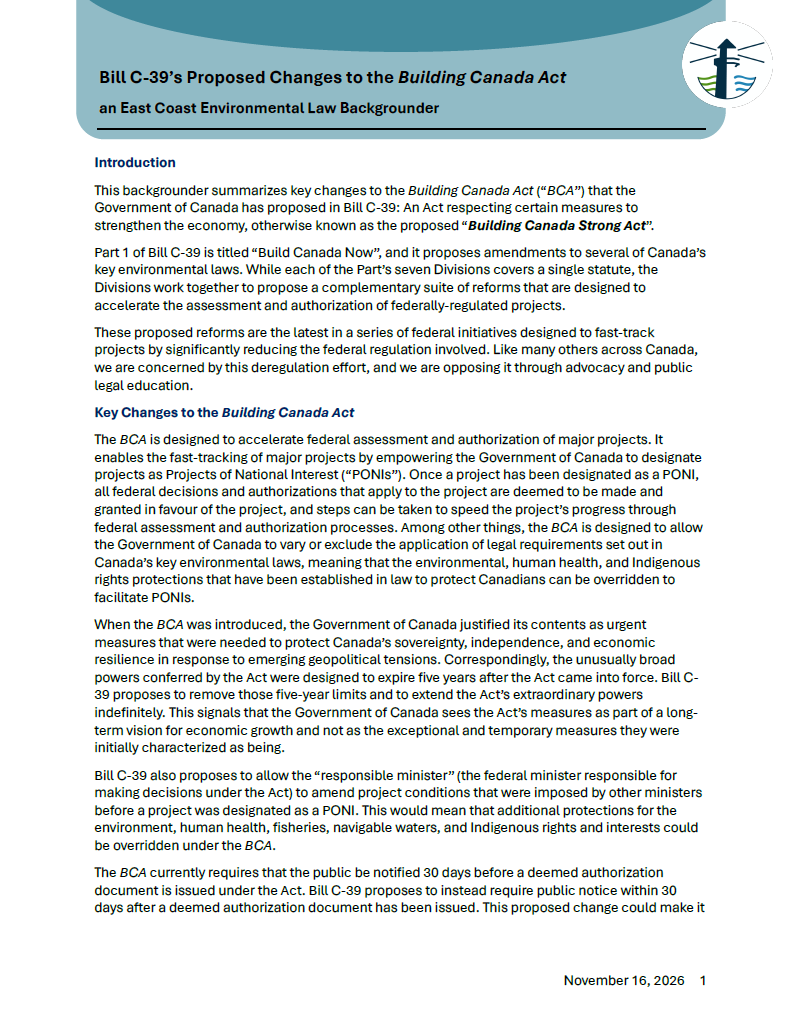
Backgrounder: Bill C-39’s Proposed Changes to the Building Canada Act
This backgrounder summarizes key changes to the Building Canada Act (“BCA”) that the Government of Canada has proposed in Bill C-39: An Act respecting certain measures to strengthen the economy, otherwise known as the proposed “Building Canada Strong Act”.
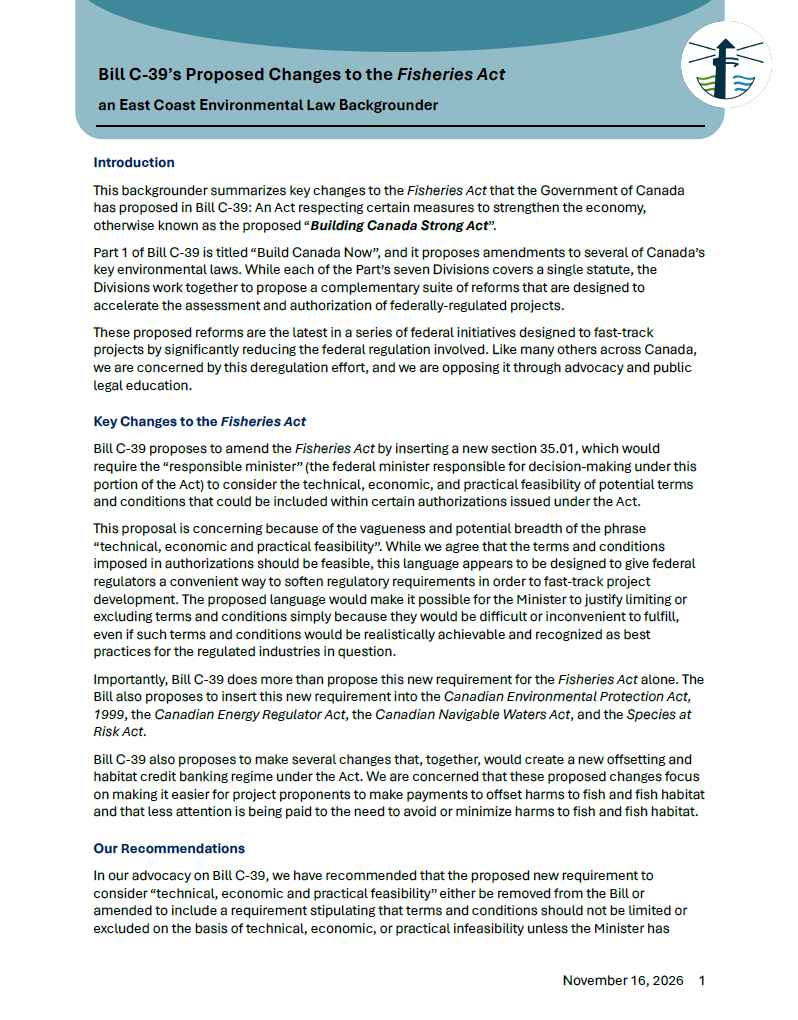
Backgrounder: Bill C-39’s Proposed Changes to the Fisheries Act
This backgrounder summarizes key changes to the Fisheries Act that the Government of Canada has proposed in Bill C-39: An Act respecting certain measures to strengthen the economy, otherwise known as the proposed “Building Canada Strong Act”.
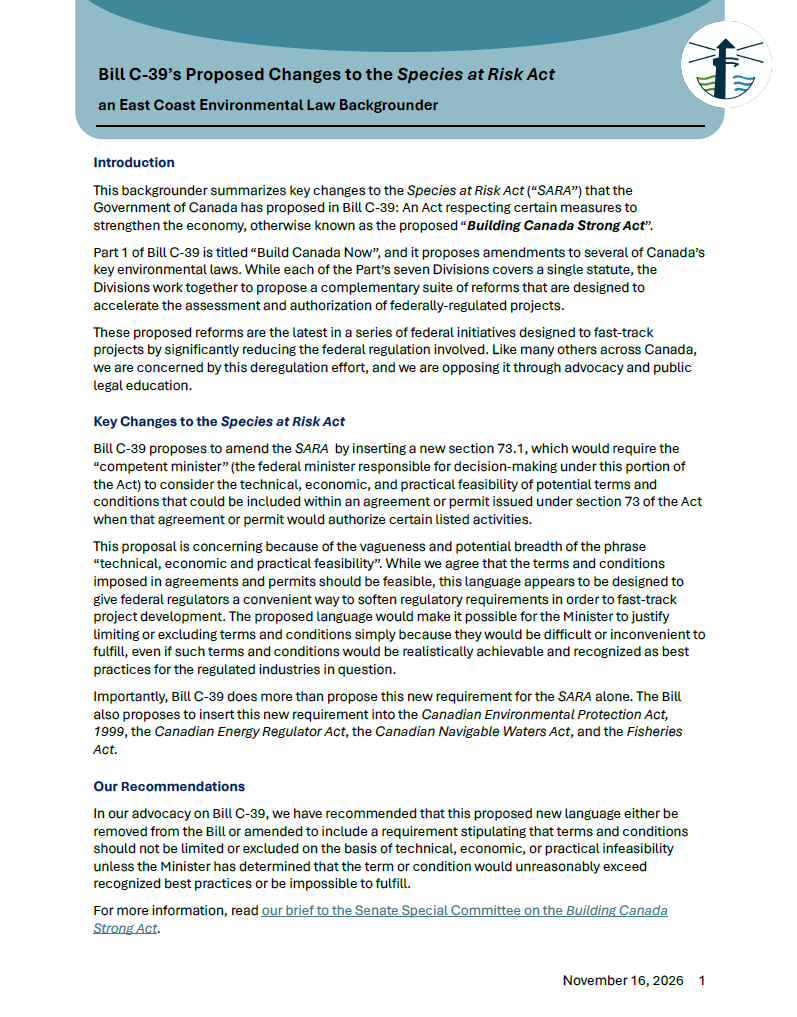
Backgrounder: Bill C-39’s Proposed Changes to the Species at Risk Act
This backgrounder summarizes key changes to the Species at Risk Act (“SARA”) that the Government of Canada has proposed in Bill C-39: An Act respecting certain measures to strengthen the economy, otherwise known as the proposed “Building Canada Strong Act”.
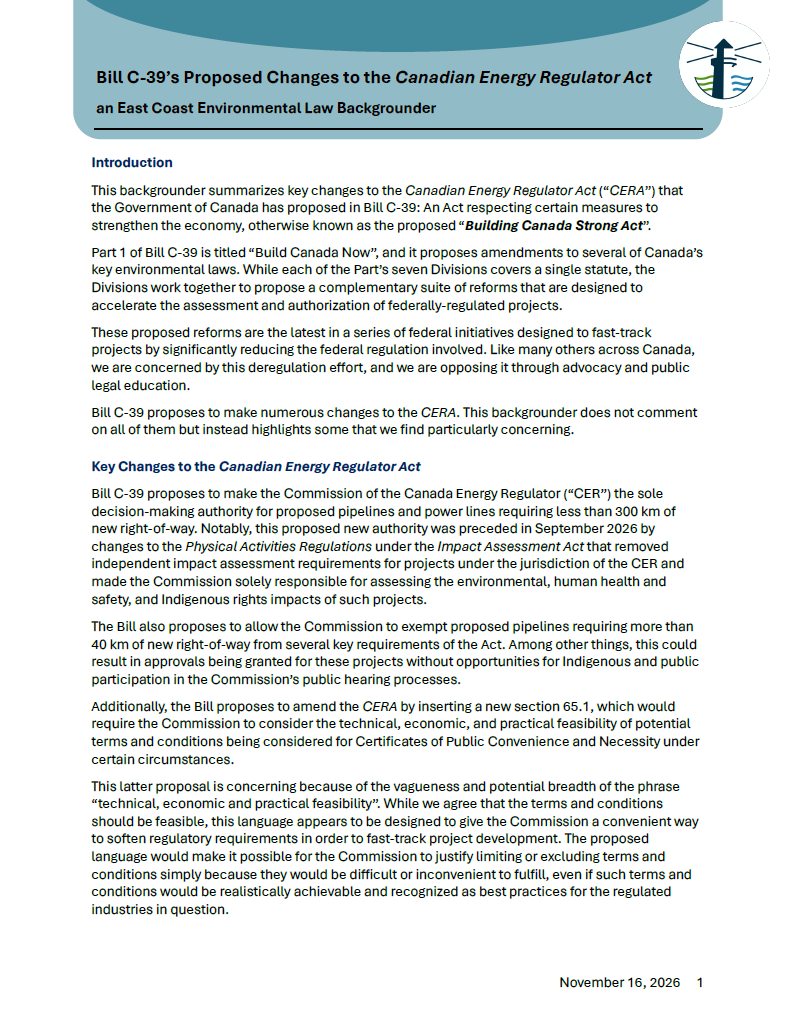
Backgrounder: Bill C-39’s Proposed Changes to the Canadian Energy Regulator Act
This backgrounder summarizes key changes to the Canadian Energy Regulator Act (“CERA”) that the Government of Canada has proposed in Bill C-39: An Act respecting certain measures to strengthen the economy, otherwise known as the proposed “Building Canada Strong Act”.
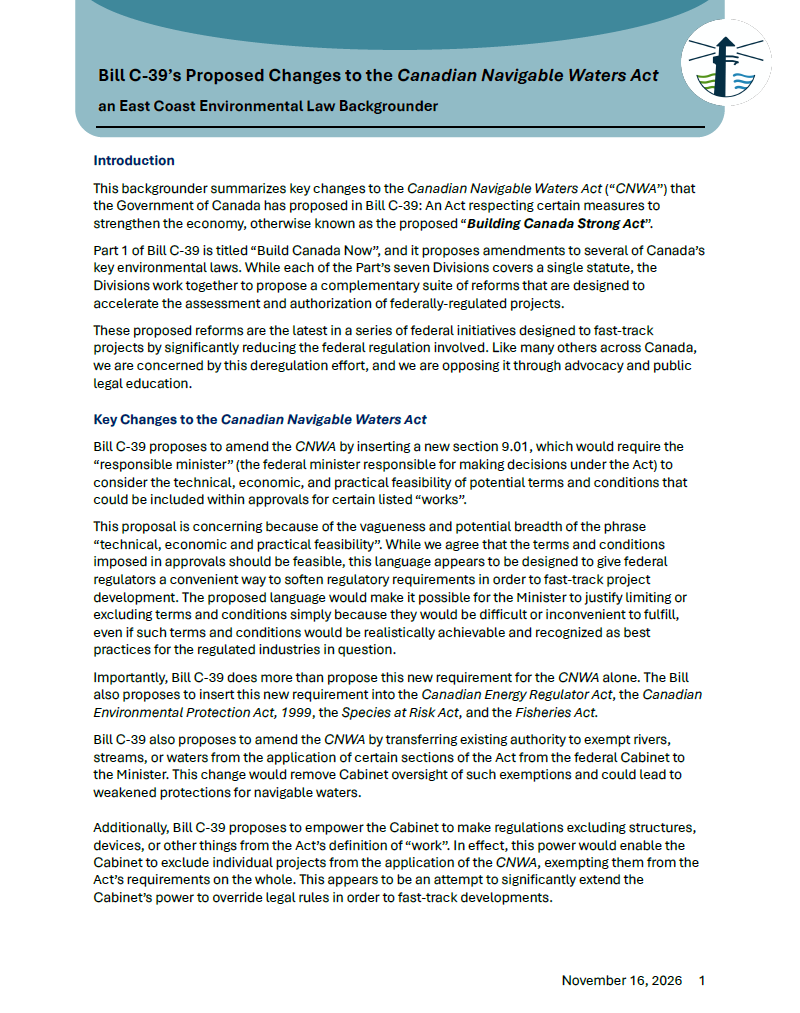
Backgrounder: Bill C-39’s Proposed Changes to the Canadian Navigable Waters Act
This backgrounder summarizes key changes to the Canadian Navigable Waters Act (“CNWA”) that the Government of Canada has proposed in Bill C-39: An Act respecting certain measures to strengthen the economy, otherwise known as the proposed “Building Canada Strong Act”.
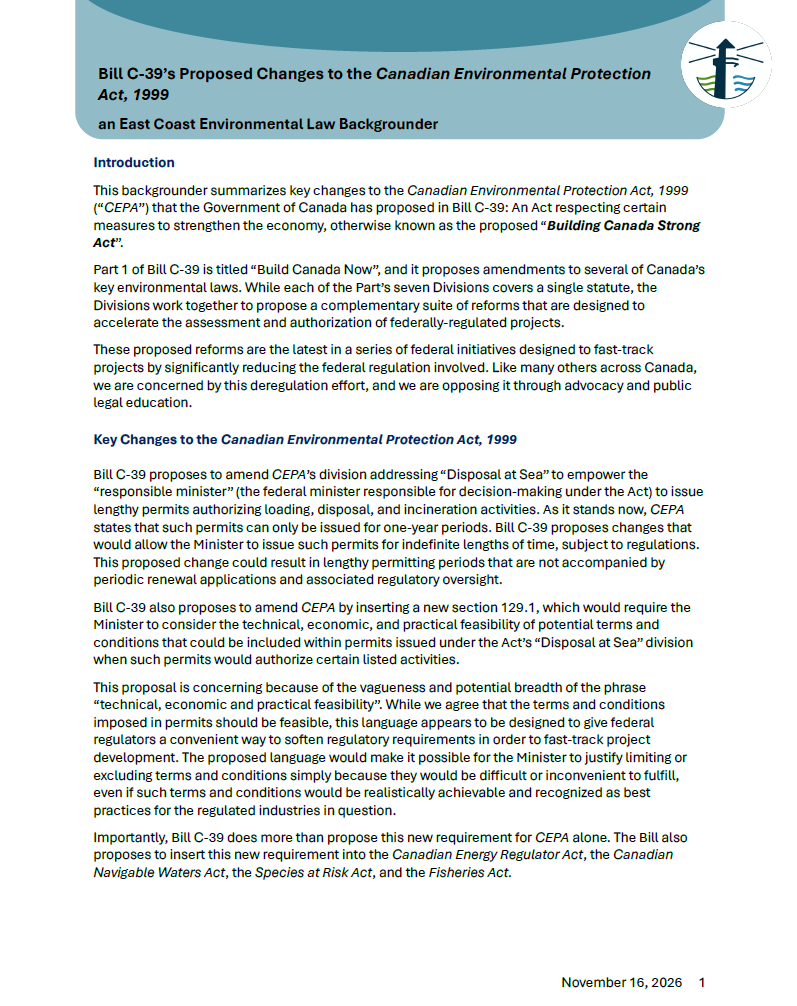
Backgrounder: Bill C-39’s Proposed Changes to the Canadian Environmental Protection Act, 1999
This backgrounder summarizes key changes to the Canadian Environmental Protection Act, 1999 (“CEPA”) that the Government of Canada has proposed in Bill C-39: An Act respecting certain measures to strengthen the economy, otherwise known as the proposed “Building Canada Strong Act”.
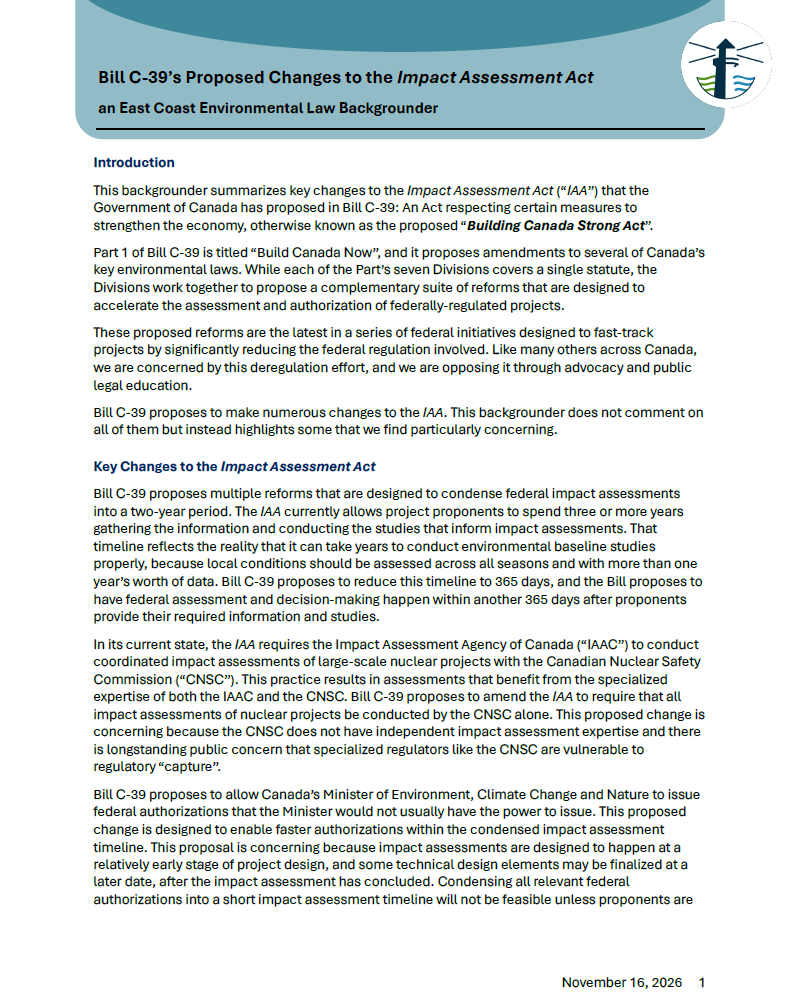
Backgrounder: Bill C-39’s Proposed Changes to the Impact Assessment Act
This backgrounder summarizes key changes to the Impact Assessment Act (“IAA”) that the Government of Canada has proposed in Bill C-39: An Act respecting certain measures to strengthen the economy, otherwise known as the proposed “Building Canada Strong Act”.

International Jurisdictional Review: Marine Spatial Planning in the Renewable Energy Transition
Marine spatial planning (“MSP”) is an important tool for managing growing demands and pressures on the ocean and maintaining healthy, productive, and resilient marine ecosystems. MSP can coordinate human activities across marine sectors and marine spaces, and can be used to identify areas for conservation, development, and co-existence. MSP can help reduce conflicts between ocean users, improve regulatory efficiency, and support a sustainable ocean economy.

Position Paper on Marine Spatial Planning and Marine Biodiversity Conservation in Canada in the Renewable Energy Transition
The purpose of this position paper is to assess the state of marine spatial planning (“MSP”) in Atlantic Canada and to identify opportunities and challenges for developing an effective and legally binding MSP regime in the region, with the objective of contributing to marine ecosystem protection and sustainable ocean development.

Brief to the Special Senate Committee on the Building Canada Strong Act on Bill C-39
Moving at the speed of good process takes time, but it is time well spent when effective assessment and authorization processes support the following: meaningful Crown-Indigenous consultation and the securing of Indigenous peoples’ free, prior, and informed consent (“FPIC”); meaningful public engagement; complete effects assessment; the identification of major projects that have the best potential to contribute positively to sustainable development in Canada; and, the imposition of mitigation, accommodation, and monitoring measures that will avoid harms and contribute to positive outcomes. Strong assessment and authorization processes can support all of these crucial components while also using time and resources economically. Informed and nuanced tailoring can improve regulatory efficiency, but sweeping deregulation will be counterproductive in the long run.

Brief to the House of Commons Legislative Committee on Bill C-39
Moving at the speed of good process takes time, but it is time well spent when effective assessment and authorization processes support the following: meaningful Crown-Indigenous consultation and the securing of Indigenous peoples’ free, prior, and informed consent (“FPIC”); meaningful public engagement; complete effects assessment; the identification of major projects that have the best potential to contribute positively to sustainable development in Canada; and, the imposition of mitigation, accommodation, and monitoring measures that will avoid harms and contribute to positive outcomes. Strong assessment and authorization processes can support all of these crucial components while also using time and resources economically. Informed and nuanced tailoring can improve regulatory efficiency, but sweeping deregulation will be counterproductive in the long run.

Joint Letter to House Leaders on Committee Consideration of Bill C-39, the Building Canada Strong Act
Bill C-39 is 232 pages long and amends 18 statutes and four regulations, enacts a new law and repeals a law. It is complex and will have far-reaching implications related to the environment, public health and safety, workers rights and trade and transportation. Its many provisions require careful, expert scrutiny that cannot be adequately addressed through a single, newly formed committee alone.

Comprendre ton droit à un environnement sain: guide à l’intention des jeunes du Nouveau-Brunswick
Le droit de la personne à un environnement sain est aussi parfois appelé « droit environnemental ». Les droits environnementaux protègent le droit d’une personne de vivre dans un environnement sain. Cela peut comprendre le droit de boire de l’eau potable, de respirer un air pur et de vivre dans un milieu où la biodiversité est en santé
Les droits environnementaux peuvent contribuer à faire évoluer la prise de décisions, en passant de la gestion de la pollution à la protection de la santé humaine et de celle des écosystèmes. Le Nouveau-Brunswick ne protège pas encore, dans ses lois provinciales, le droit des Néo-Brunswickois à un environnement sain, mais de nombreuses personnes militent pour que notre gouvernement franchisse cette étape.

Understanding Your Right to a Healthy Environment: A Guide for New Brunswick Youth
The human right to a healthy environment is also sometimes called an “environmental right”. Environmental rights protect a person’s right to live within a healthy environment. This can include the right to drink clean water, breathe clean air, and live among healthy biodiversity.
Environmental rights can help shift the focus of decision-making from managing pollution to protecting human and ecosystem health. New Brunswick does not yet protect New Brunswickers’ rights to a healthy environment in provincial law, but many people have been advocating for our government to take this step.

Guide to Offshore Wind Law and Policy in Newfoundland and Labrador
This guide to offshore wind law and policy in Newfoundland and Labrador provides an overview of the law and policy regimes that govern offshore wind regulation under the CAN-NL Accord Acts. It is intended to be an accessible introduction to offshore wind regulation in Newfoundland and Labrador, and it does not cover every detail of the applicable laws and policies.

Guide to Offshore Wind Law and Policy in Nova Scotia
This Guide to Offshore Wind Law and Policy in Nova Scotia provides an overview of the law and policy regimes that govern offshore wind regulation under the CAN-NS Accord Acts. It is intended to be an accessible introduction to offshore wind regulation in Nova Scotia, and it does not cover every detail of the applicable laws and policies.

Submission on “Proposed Critical Habitat Protection Regulations for federal lands made under section 59 of the Species at Risk Act”
ECEL wishes to express support for ECCC’s proposal. It is an important example of regulatory change that can both improve efficiency and strengthen environmental protection. Automatic protection for critical habitat for terrestrial species listed under SARA on applicable federal lands would provide a portion of the legal protection mandated by SARA, while avoiding the need for separate reviews, regulatory processes, or orders for each species.

Guide du droit de l’environnement au Nouveau-Brunswick - Troisième édition
Le présent Guide du droit de l’environnement au Nouveau-Brunswick est basé sur une publication similaire publiée par le Conservation Council of New Brunswick en 2000 : Handbook on Environmental Law for New Brunswick.
Cette version révisée et mise à jour a été préparée par le personnel de East Coast Environmental Law, et sa première édition a été publiée en juin 2023. La deuxième édition a été publiée en mars 2025 et cette troisième édition a été publiée en septembre 2026. Un examen et des commentaires ont été fournis par de nombreux étudiants, académiques et professionnels du droit, à qui nous sommes reconnaissants.
Soutenu par une subvention de la Fondation pour le droit au Nouveau-Brunswick.

Guide to Environmental Law in New Brunswick - 3rd Edition
This Guide to Environmental Law in New Brunswick is based on a similar publication: a Handbook on Environmental Law for New Brunswick that was published by the Conservation Council of New Brunswick in 2000.
This revised and updated version was prepared by the staff lawyers of East Coast Environmental Law, and its first edition was published in June 2023. The second edition was published in March 2025 and this third edition was published in September 2026. Input and content review has been provided by a number of students, scholars, and legal professionals, to whom we are very grateful.
Supported by a grant from the New Brunswick Law Foundation.

Municipal Coastal Protection in Nova Scotia: Municipal Planning Strategies and Land-Use By-Laws
Given the essential role of municipal governments in coastal protection and management, East Coast Environmental Law sought to examine how municipalities in Nova Scotia deal with coastal issues by reviewing each municipal planning strategy (“MPS”) and land-use by-law (“LUB”). This report summarizes the scope and breadth of municipal rules and approaches to coastal protection and management.
Our Summary Series
Welcome to our signature Summary Series—your first step to becoming more informed about environmental laws in Atlantic Canada.



Featured Library Resources
Check out some of our latest research reports, guides, and law reform papers.

