Our Newsletter and ECEL
In The News
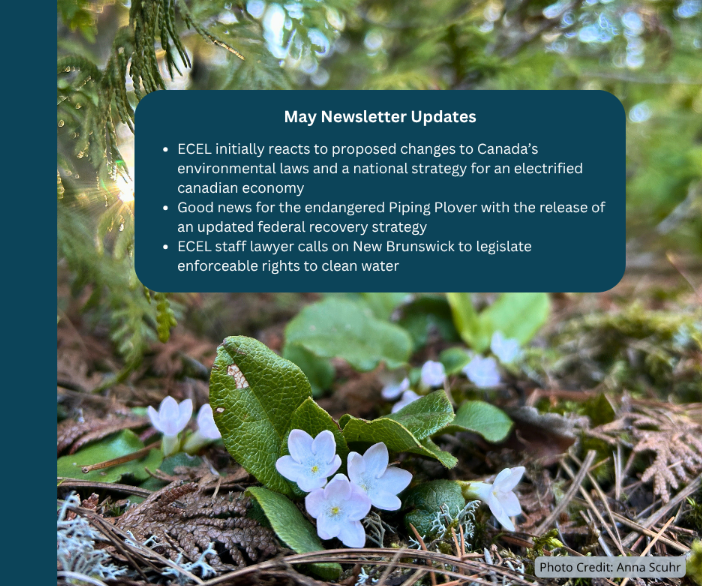
May is a month of renewal. Flowers bloom, trees leaf out, and the coast comes alive as migratory birds return for breeding season and resident wildlife re-emerge from their winter rest. It’s a fitting reminder of the species and ecosystems worth protecting.
Earth Day began in 1970 as a collective call to action with millions of people coming together to demand better protection for the environment and a healthier future for all. It was rooted in a simple but powerful belief: that people, working together, can create meaningful change. More than 50 years later, that spirit feels as important as ever.
The New Brunswick Energy and Utilities Board hearing on New Brunswick Power’s proposed RIGS Project concluded on April 1st. We represented the Conservation Council of New Brunswick in the proceeding, with staff lawyer Tina Northrup taking the lead on the file.
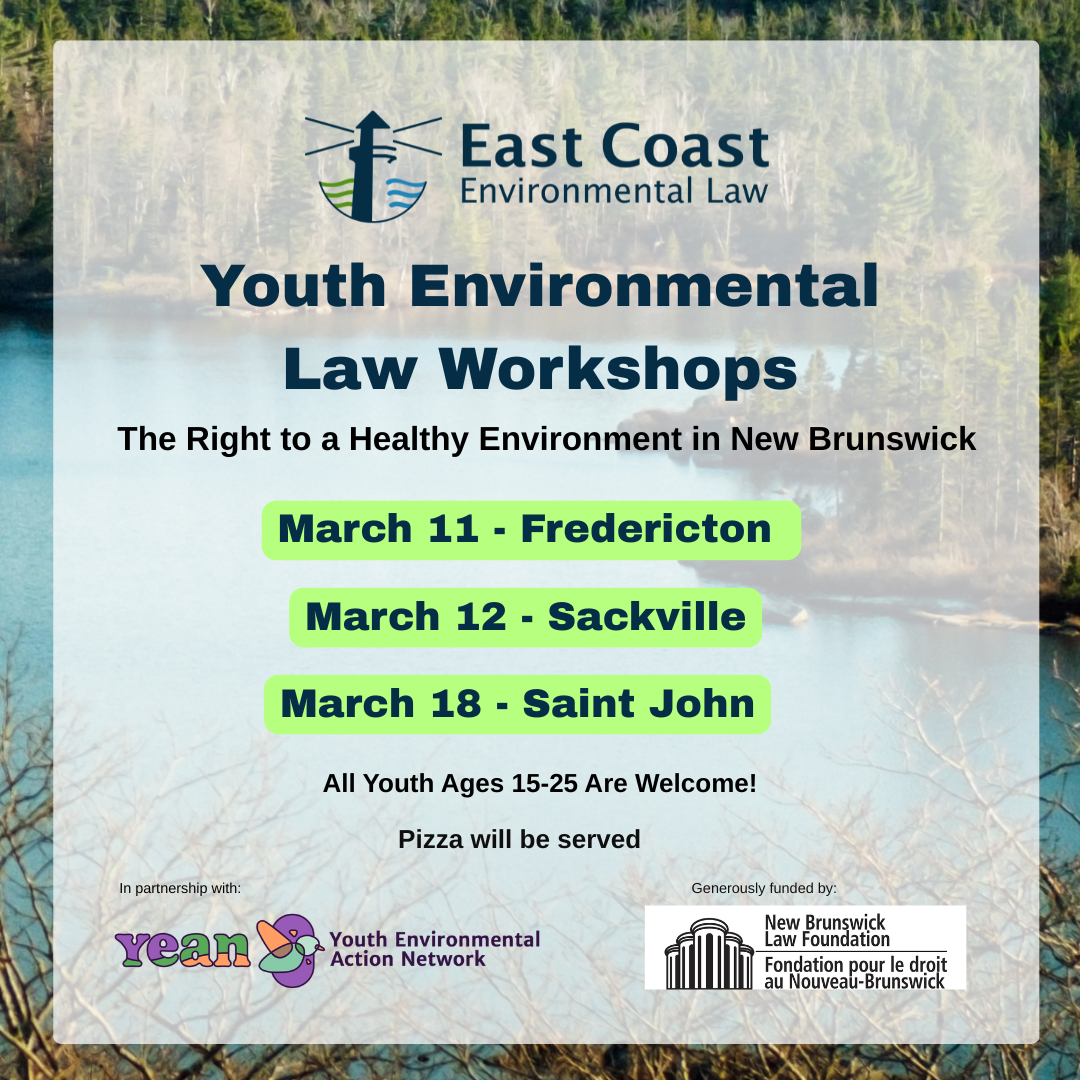
We’ve been preparing a series of youth environmental law workshops focused on the right to a healthy environment in New Brunswick. Over the next few weeks, we’ll be meeting with youth across the province to explore how environmental rights take shape through law, policy, and public participation.
We continue to engage in law reform initiatives in Atlantic Canada to protect wetland ecosystems. Check out our most recent blog post that discusses the ongoing review of New Brunswick’s Clean Air Act and Clean Water Act, highlighting our staff lawyers’ recommendations to strengthen environmental protection, transparency, and enforcement.
As the year comes to a close, we want to say thank you to everyone who has supported East Coast Environmental Law and worked alongside us to advance our mission in 2025. We wish you all a very Happy New Year.
A Few Highlights From 2025
Thank you to everyone who has given today and in the last few weeks to support our wetlands protection work. If you want to support the work that we do and help us to protect wetlands in Atlantic Canada, there’s still time!
Today is Giving Tuesday, and we’re asking for your support to help us expand our wetlands protection work across Atlantic Canada. Wetlands are vital ecosystems that need stronger legal protection. Despite the growing need for advocacy and support, much of our work to protect wetlands is not directly funded.
Blue carbon refers to carbon dioxide that is sequestered (stored) by coastal or marine ecosystems such as salt marshes and seagrass meadows. These blue carbon ecosystems draw down and store significant amounts of carbon in their sediments long-term, reducing the amount of CO₂ in the atmosphere more than terrestrial ecosystems like forests do. In Atlantic Canada, both salt marshes and seagrass meadows are under threat of being degraded and destroyed by industrial activities and coastal development.
For years, we’ve been advocating for the protection of wetlands in Nova Scotia by participating in the annual Wetlands Appreciation Week and developing resources like the Guide to Municipal Wetlands Stewardship in Nova Scotia and Legal and Policy Tools to Protect Wetlands in Nova Scotia. This year, we’re asking for your support so we can continue to expand our work and develop more resources for communities that are working to protect wetlands across Atlantic Canada.
On October 16, 2025, the Canada–Nova Scotia Offshore Energy Regulator (“CNSOER”) issued a Call for Information that invites feedback on a number of topics that will inform Atlantic Canada’s first offshore wind licencing process.
Join East Coast Environmental Law staff lawyers, Mike Kofahl and Richelle Martin, in Charlottetown, PEI on October 23rd from 6:00PM - 8:30PM for a free environmental law education workshop about coastal access law and policy.
We’ve published some new public resources on offshore wind law, policy, and assessments in Newfoundland and Labrador and Nova Scotia!
We're looking forward to delivering two environmental law workshops this September in Newfoundland and Labrador! Generously supported by a grant from the Law Foundation of Newfoundland and Labrador, our upcoming workshops will be free and open to the public.
Now in its third year in Nova Scotia, Wetlands Appreciation Week will take place from August 9th - 17th, with events taking place every day across the province and online! As part of the week’s activities, East Coast Environmental Law will be co-presenting a lunch-and-learn webinar with Birds Canada on the topic of Private Landowner Wetland Conservation.
For more than a decade, East Coast Environmental Law has been advocating for legal recognition of human rights to a healthy environment in Atlantic Canada. Most recently, we've been working in New Brunswick and Nova Scotia to share why legislated rights to a healthy environment are so important. We've been speaking to community gatherings, the press, and government representatives. And today, we've published a series of interviews with community leaders in Nova Scotia who have deep-rooted perspectives on environmental and climate justice and the need for environmental rights recognition.
In 2022, Ecojustice, on behalf of East Coast Environmental Law and Nature Nova Scotia, launched a judicial review proceeding that asks Canada's Federal Court to review changes that were made to the federal recovery strategy for Piping Plover–changes that, in our view, weakened the process to identify and protect the species’ critical habitat. Next week, Ecojustice will represent us in Federal Court to argue for stronger critical habitat protections for the Piping Plover.
Our first in-person workshop of the year will be on The Law and Policy of Herbicide Spraying on Crown Lands in New Brunswick. Join us from 6:30-8:30 PM on Wednesday, May 28th at the Mapleton Park Rotary Lodge in Moncton, New Brunswick to hear from staff lawyers Richelle Martin and Tina Northrup, as well as members of the Conservation Council of New Brunswick and Stop Spraying NB.
The East Coast Environmental Law team has been busy this winter, with new public legal education resources in development, new blog posts published, and new submissions to government on the need for transparency, accountability, and good process in environmental governance and decision-making.
We’re excited to share several new resources that are now available on our website and YouTube channel!
The postal strike at the end of 2024 was challenging for many charities that rely on receiving donations by mail, as well as for donors who are used to sending year-end donations by post. The Canada Revenue Agency recently confirmed that charitable donations submitted by February 28, 2025 can be applied to 2024 or 2025 income tax returns.
On February 5th, join East Coast Environmental Law for a free webinar on the federal and provincial assessment processes that apply to renewable energy infrastructure in Newfoundland and Labrador. This public legal education session will aim to demystify assessments and share tips on how to navigate them effectively.
With the end of the year fast approaching, this is a season for rest and reflection. Before we advance into the new year, we’re taking a moment to look back over the year and celebrate our successes.
Thanks to our generous contributors, we reached our fundraising goal this Giving Tuesday!
We’re now taking a moment to say thank you to our supporters for continuing to trust us to advocate for progressive environmental law and policy in Atlantic Canada, provide public legal education, and share our legal skills to support others who are working to prevent or redress environmental harms.
This Giving Tuesday, we’re envisioning a future in which all Atlantic Canadians have a legislated right to clean air, clean water, and clean soil. We appreciate each and every one of your donations to help us engage in environmental rights advocacy in New Brunswick, Newfoundland and Labrador, Nova Scotia, and Prince Edward Island.
The environment where we live determines our health, and none of us are protected when environmental laws don’t recognize or protect community members’ rights to ask questions, engage, and speak out against projects that will be damaging for current and future generations.
By supporting East Coast Environmental Law this Giving Tuesday, you’ll support environmental rights advocacy in Atlantic Canada.
This Giving Tuesday, we’re asking supporters to empower our environmental rights advocacy throughout Atlantic Canada. Residents of Newfoundland and Labrador, New Brunswick, Nova Scotia, and Prince Edward Island deserve legal rights to a healthy environment and liveable climate, but those rights aren’t yet recognized or protected in our provincial laws.
Since its launch last week, our campaign to win a right to a healthy environment in Nova Scotia has been gaining momentum!
Since 2015, East Coast Environmental Law has been assessing and reporting on how provincial governments in Atlantic Canada are implementing their laws to protect species at risk. We’ve been asking: Are species being assessed and designated as being in need of protection? Are timelines and obligations for management and recovery planning being met? Are species’ habitats being protected?
-
Below you will find the latest articles featuring ECEL staff and the work that has caught our attention.
-
Caught Our Attention: Carney moves to fast-track federal approval for major projects — from pipelines to power lines
A National Observer article published May 12, 2026 reports that Prime Minister Mark Carney has vowed to introduce legislation that would make it quicker and easier for major projects to receive federal approval, with the overarching goal of limiting federal regulatory approvals to one year for all projects. The proposed changes would expand ministerial powers, make it easier to obtain permits under multiple federal laws, and shift pipeline approvals to the Canada Energy Regulator, removing the need for a separate assessment by the Impact Assessment Agency.
-
Caught Our Attention: Ottawa proposes suite of measures to streamline project approvals, complete review process within 1 year
A CBC News article published May 8, 2026 reports that the federal government is proposing legislative changes to streamline the review process for major projects, including energy projects such as pipelines, with the goal of completing these reviews within one year. The proposed changes, which drew criticism from environmental groups and a former Liberal environment minister, include conducting federal impact assessments and permit reviews simultaneously rather than one after another.
-
Featuring ECEL Staff: Conflicting views about water protection heard as MLAs review Clean Water Act
A CBC News article published May 5, 2026 reports that a review of New Brunswick's 37-year-old Clean Water Act got underway with forestry representatives defending the current law while others, including environmental advocates, called for stronger protections. ECEL's Richelle Martin urged the legislative committee to enshrine the legal right to clean water into law, arguing that a stronger law is needed to ensure equal access to the resource for all.
-
Featuring ECEL Staff: New Brunswick should enshrine into law the right to clean water, says lawyer
A Global News article published May 5, 2026 reports that ECEL's Richelle Martin called on the New Brunswick legislature to enshrine the legal right to clean water, telling a committee reviewing the Clean Water Act that the absence of such a law can lead to unequal access to the resource. Martin's appeal was met with pushback from forestry giant J.D. Irving, whose representatives warned the committee that stronger regulations could negatively impact the province's economy and the competitiveness of its forestry industry.
-
Featuring ECEL Staff: Stronger federal protections for piping plovers applauded
A CBC News article published May 1, 2026 highlights that shorebird advocates are welcoming stronger protections for piping plovers following a landmark Federal Court of Canada decision, which prompted Environment and Climate Change Canada to release a revised recovery strategy for the endangered species. The birds nest each spring along Kouchibouguac National Park in eastern New Brunswick and other sandy beaches across Atlantic Canada and Quebec, where they face threats from human activity, predation, and flooding.
-
Featuring ECEL Work: Ecojustice, Nature Nova Scotia laud ‘major win’ for protection of piping plovers’ critical habitat
A Halifax Examiner article published on April 30, 2026 highlights that Ecojustice and Nature Nova Scotia are lauding a major win for the protection of piping plovers' critical habitat, after Environment and Climate Change Canada rewrote its recovery strategy to protect entire beaches for the endangered shorebirds. The updated strategy is the result of a hard-fought court battle in which Ecojustice, representing Nature Nova Scotia and ECEL, successfully challenged the federal government's flawed approach to identifying piping plover habitat. Please note this article is behind a paywall.