
Resource Library
Welcome to the East Coast Environmental Law Resource Library. Here, you can find a wide range of resources on environmental law issues throughout Atlantic Canada.
Explore our FAQs to learn more about our Resource Library and what it contains.
If you want accessible learning materials on general topics, try searching our Summary Series first to see if we have a guide or toolkit that meets your needs.
Have a question that isn’t answered by our existing guides and toolkits? Submit an Environmental Law Inquiry by using our Inquiry Intake Form.
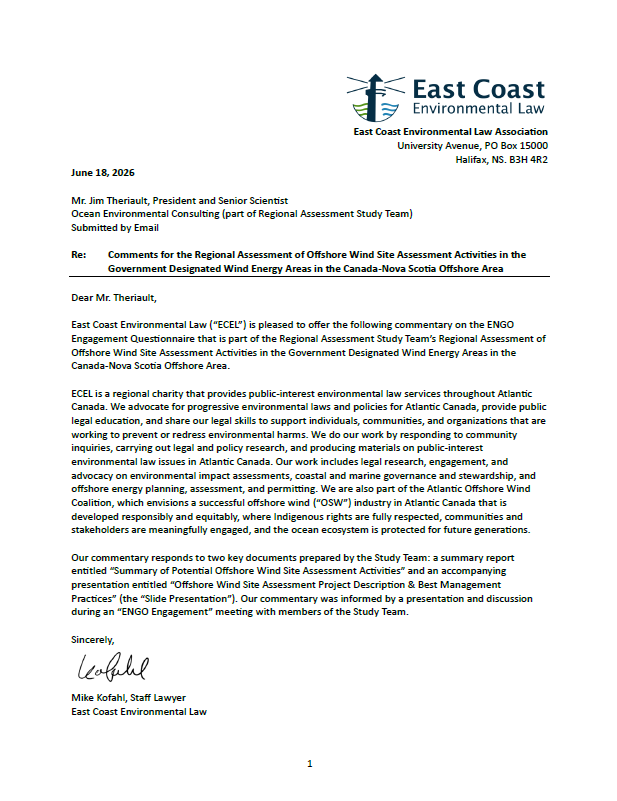
Comments for the Regional Assessment of Offshore Wind Site Assessment Activities in the Government Designated Wind Energy Areas in the Canada-Nova Scotia Offshore Area
Our commentary responds to two key documents prepared by the Study Team: a summary report entitled “Summary of Potential Offshore Wind Site Assessment Activities” and an accompanying presentation entitled “Offshore Wind Site Assessment Project Description & Best Management Practices” (the “Slide Presentation”). Our commentary was informed by a presentation and discussion during an “ENGO Engagement” meeting with members of the Study Team.
Submission on the Draft Terms of Reference for the Regional Assessment of Oil and Gas Exploratory Drilling in the Canada-Nova Scotia Offshore Area
Ideally, RAs will be used to contribute regional-scale cumulative effects assessments and enhance our collective understanding of how projects and activities contribute to long-term sustainability in the face of the climate emergency, extinction-level biodiversity loss, and global pollution. Used appropriately and effectively, regional assessment is a valuable—even essential—tool to facilitate early planning, consultation, engagement, and scientific study, which will make future, project-level planning and assessment processes more rigorous, consistent, and predictable.
Joint Letter with Recommendations for Advancing Action on Marine Conservation in Atlantic Canada
We write as civil society organizations, which work collaboratively with Indigenous groups, governments, industry, and coastal communities to support Canada in reaching its commitments to protect the marine environment in Atlantic Canada (Waponahkik). While we are pleased that Canada’s “A Force of Nature” has been released, we are highly concerned that efforts in Atlantic Canada have stalled as a result of provincial government opposition and that opportunities to leverage federal commitments to support industrial development are not being taken to support conservation.
Joint Letter to the Minister of Fisheries Re: Concerns about Discussion Paper on Proposed Reforms for “Getting Major Projects Built”
We are among the conservation and environmental non-governmental organizations (NGOs) from across the country that worked with your government for over four years to help modernize the Fisheries Act, one of Canada’s oldest laws. The Fisheries Act is also one of Canada’s strongest environmental laws, particularly following the 2019 modernization and restoration of lost protections that occurred in 2012. We have continued working in good faith with your department to implement the Act and to protect fish and fish habitat.
Joint Letter to the Minister of Environment Re: Concerns about the Regional Assessment of Offshore Oil and Gas Exploratory Drilling in the Offshore Area of Nova Scotia
The Nova Scotia Government requested the proposed RA to accelerate oil and gas exploration by exempting projects from impact assessment (“IA”). That contradicts the fundamental purpose of RAs under the Impact Assessment Act. RAs are intended to be independent planning tools that support project-level IAs through the study of regional impacts, cumulative effects and long-term sustainability. RAs are not intended to fast-track resource development by exempting projects from IAs.
Brief to the Standing Committee on Fisheries and Oceans Re: Marine and Coastal Protections
Canada’s commitment to protecting at least 30% of the ocean by 2030 is grounded in Canadian and international law and policy, and is a necessary contribution to global conservation efforts intended to prevent ecosystem collapse and biodiversity loss in the ocean.
East Coast Environmental Law Responses to Call for Information NS25-1R
This submission responds to the questions posed in the Call for Information feedback form on the CNSOER website, addressing those questions in the same order in which they appear online.

Streamlining the Assessment and Authorization of Offshore Wind Projects: Surveying Major Law Reform Initiatives in Canada and Abroad
Recently, the urgency of the climate crisis has been growing in tandem with geopolitical tensions that are motivating Canada to accelerate energy projects that can strengthen energy independence and provide greater energy security. Breaking barriers to interprovincial trade, exploring possibilities for regional collaboration, and finding ways to build new energy infrastructure faster are among the many aspirations of the current political moment.
Op-Ed by Lisa Mitchell Originally Published in the Chronicle Herald on September 26, 2025: Wind West Can Power Canada’s Future — Let’s Build It Right
The momentum is real, and the moment feels rare — a convergence of economic opportunity, climate ambition, and political will. Shortly after Wind West was named as a future addition to the Building Canada Act project list, Nova Scotia’s Premier released a bold strategic plan and took out a full front-page newspaper ad to rally public support.

Position Paper on the Conclusion of the Regional Assessment of Offshore Wind Development in Newfoundland and Labrador: Reflections on Key Findings and Next Steps
East Coast Environmental Law participated in the Regional Assessment as one of many public stakeholder groups. While participating in the assessment, we also contributed to federal and provincial law reform initiatives that were establishing new regulatory regimes for offshore wind development in Atlantic Canada.

Position Paper on the Conclusion of the Regional Assessment of Offshore Wind Development in Nova Scotia: Reflections on Key Findings and Next Steps
East Coast Environmental Law participated in the Regional Assessment as one of many public stakeholder groups. While participating in the assessment, we also contributed to federal and provincial law reform initiatives that were establishing new regulatory regimes for offshore wind development in Atlantic Canada.

Backgrounder: The Regional Assessment of Offshore Wind Development in Nova Scotia
In January 2025, the Regional Assessment of Offshore Wind Development in Nova Scotia (“Regional Assessment”) concluded. This backgrounder offers an overview of the Regional Assessment, explaining its origins and purpose as well as the role it is expected to play in the future regulation of offshore wind developments in Nova Scotia.

Submission to the Canada-Nova Scotia Offshore Energy Regulator on the Petroleum-related Call for Bids NS25-1P
Submission to the Canada-Nova Scotia Energy Regulator on the Petroleum-related Call for Bids NS25-1P.
Joint Letter Re: MPA Network Plan and Fundian Channel - Browns Bank MPA Designation
The development of the MPA Network Plan has involved more than a decade of extensive investment from many stakeholders and rightsholders, as well as public consultation from communities in Nova Scotia and New Brunswick. Given this level of engagement and the support it reflects, it is both timely and appropriate for the federal government to move forward with its release as soon as possible.
Comments on the Government of Canada’s Intentions Related to Regulating Offshore Carbon Dioxide Storage in Sub-Seabed Geological Formations
The Government of Canada sought input on an Intentions Paper in which it proposes to develop a regulatory framework for offshore sub-seabed geological carbon dioxide (CO2) storage. This work is being undertaken as part of Canada’s Carbon Management Strategy.
Joint Letter to Minister Re: Fisheries Act Implementation
Joint Letter to Minister re: Fisheries Act Implementation

Submission on the Proposed Canada-Nova Scotia Offshore Wind Energy Areas Engagement
East Coast Environmental Law’s submission on the proposed Wind Energy Areas (“WEAs”) that the Government of Canada and Government of Nova Scotia have presented as prospective locales for offshore wind development.

SeaBlue Canada Submission: Engagement on Offshore Wind Energy Areas for Nova Scotia
SeaBlue Canada Submission: Engagement on Offshore Wind Energy Areas for Nova Scotia

Submission on the Draft Terms of Reference for the Regional Assessment of the St. Lawrence River Area
East Coast Environmental Law’s Submission to the Impact Assessment Agency of Canada on the Draft Terms of Reference for the Regional Assessment of the St. Lawrence River Area.

Our Summary Series
Welcome to our signature Summary Series—your first step to becoming more informed about environmental laws in Atlantic Canada.



Featured Library Resources
Check out some of our latest research reports, guides, and law reform papers.