Our Newsletter
September 2026
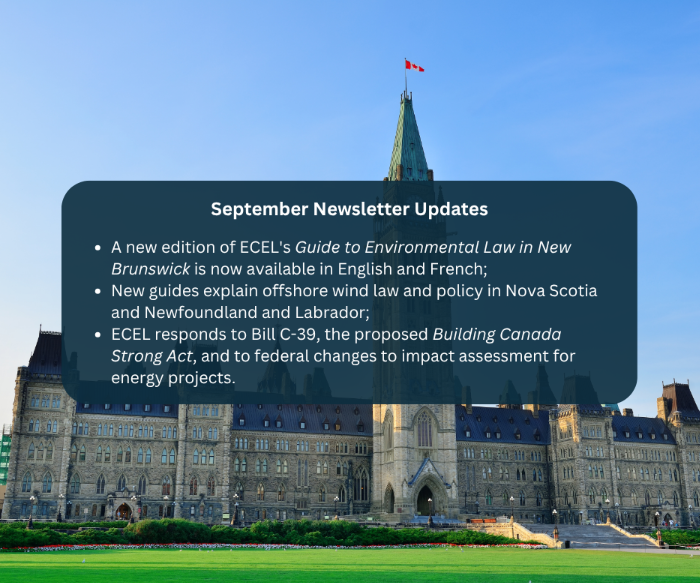
This month, ECEL released the third edition of its Guide to Environmental Law in New Brunswick, along with two new guides on offshore wind law and policy in Nova Scotia and in Newfoundland and Labrador. ECEL also issued statements on Bill C-39, the proposed Building Canada Strong Act, and on recent changes to impact assessment requirements for federally regulated energy projects. We hope that you enjoy getting caught up with everything ECEL has been up to.

August 2026
This month's newsletter looks back at a busy August: a public webinar on the law and policy of herbicide spraying on Crown lands in New Brunswick, a new report on municipal coastal protection in Nova Scotia, our participation in Nova Scotia's Wetlands Appreciation Week, and our annual staff retreat in Fredericton. As always, we've rounded up recent media coverage featuring ECEL and the environmental law issues on our radar.

July 2026
As summer continues across Atlantic Canada, our team has been busy weighing in on some of the region's most consequential federal and provincial processes and celebrating the wetlands that sustain our coastlines and communities. This month's newsletter reflects that work, from a proposed mining project in Nova Scotia to the federal government's proposed changes to environmental review processes, offshore wind development in Atlantic Canada, and Nova Scotia's Wetlands Appreciation Week. We hope you enjoy getting caught up with our work.

Coastal Appreciation Week
Mark your calendars for the first Nova Scotia Coastal Appreciation Week, running from July 11 to 19, 2026, in celebration of Nova Scotia's coastline and the communities that call it home. Coordinated by the Ecology Action Centre and the Coastal Coalition of Nova Scotia, this week-long celebration will bring together more than two dozen organizations hosting events across the province.

June 2026
As summer begins along the Atlantic Canadian coast, our team has been as busy as ever engaging with federal processes, standing alongside partners on marine conservation, attending conferences, and bringing environmental law education directly to communities.
This month's newsletter reflects the breadth of that work, from an offshore oil and gas regional assessment to marine protected areas, New Brunswick's environmental law reviews, and an upcoming public workshop in PEI. We hope you enjoy getting caught up with everything we've been up to.


Building on the Vision That Started Earth Day
Earth Day began in 1970 as a collective call to action with millions of people coming together to demand better protection for the environment and a healthier future for all. It was rooted in a simple but powerful belief: that people, working together, can create meaningful change. More than 50 years later, that spirit feels as important as ever.

New Brunswick Advocacy Updates, Offshore Activity in Nova Scotia and Canada’s Strategy to Protect Nature
The New Brunswick Energy and Utilities Board hearing on New Brunswick Power’s proposed RIGS Project concluded on April 1st. We represented the Conservation Council of New Brunswick in the proceeding, with staff lawyer Tina Northrup taking the lead on the file.